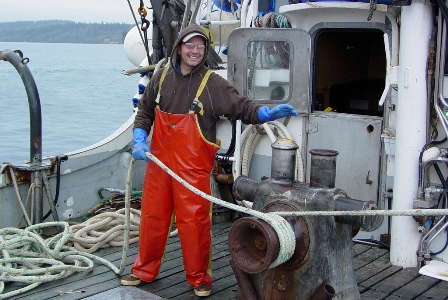
When NIOSH started investigating injuries to Alaskan seiners a few years ago, they found a common theme. Researchers were able to trace countless instances of crushing, amputation, and drowning back to getting tangled up in their gear.
"They get caught up and wrapped. And once they get wrapped, they can’t reach the controls to shut down the winch," says Chelsea Woodward. Woodward is one of four researchers on NIOSH’s commercial fishing safety team. He serves as an engineer, and it was his job to design a simple tool based on NIOSH’s seiner research.
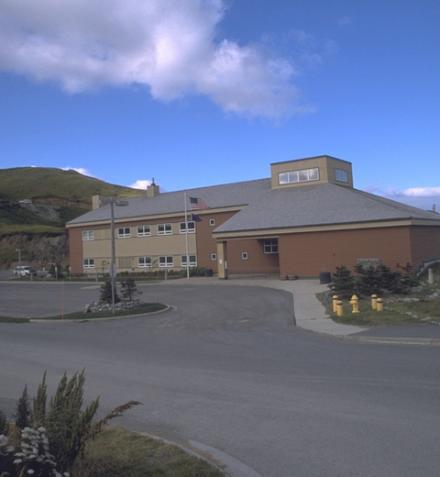
City council will meet tonight to discuss two sets of changes to the Unalaska city code.
First, council will discuss new tideland regulations that would increase typical maximum lease terms to 30 years, from the current standard of 20 years. Council will also vote on a 30-year tideland lease near Coastal Transportation’s dock. Strong Holdings would take on the lease, and sublease the property to Coastal Transportation.
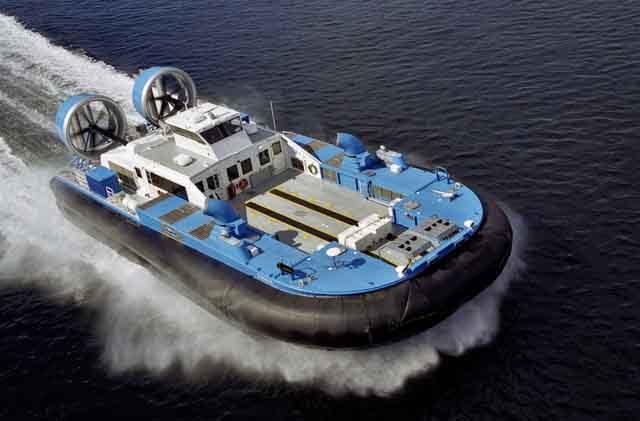
The hovercraft that will link the village of Akutan with its new airport made the trip down from Cold Bay last week. The hovercraft has a long and storied history operating in the Aleutians, but it’s the only connection between the new runway and the community of 1,000 people.
The Aleutians East Borough acquired the Suna X in 2007, to provide a transportation link between King Cove and the all-weather airport in Cold Bay. The hovercraft operated on and off for a little over two years, until 2010, when the Borough permanently suspended its operations. They cited high costs, mechanical problems and unreliability. It’s been sitting in King Cove ever since. But now, the Borough is giving it a second chance, in Akutan.
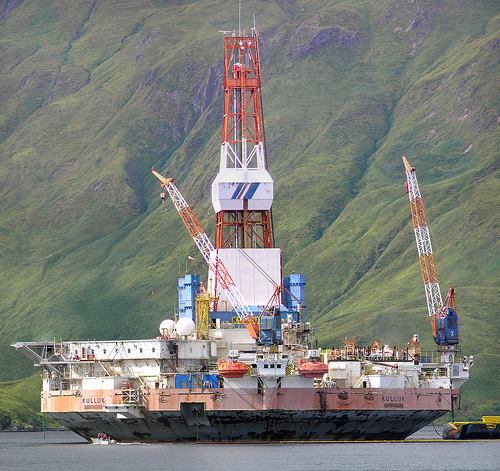
As promised, one of Shell Oil’s drill rigs left Unalaska Monday and is now bound for the Arctic.
The Kulluk drill ship departed Unalaska early in the afternoon, along with two of Shell’s tugboats, the Guardsman and the Warrior. Alaska marine pilot Richard Entenmann navigated the Kulluk, and he says their crew seemed happy to be heading north.
"They were eager," he says. "We were eager to get them out of here. It was good on all fronts.”
When Unalaskans go to vote in October’s municipal election, their options will be limited. None of the incumbents running for city council or school board face any competition.
Councilors Zac Schasteen and Tom Enlow are running in uncontested races for Seats F and G, while School Board Member Melanie Magnusen has no opponents for Seat A. The filing deadline to run for public office was Thursday.
The lack of competition makes this an unusual race according to City Clerk Elizabeth Masoni.
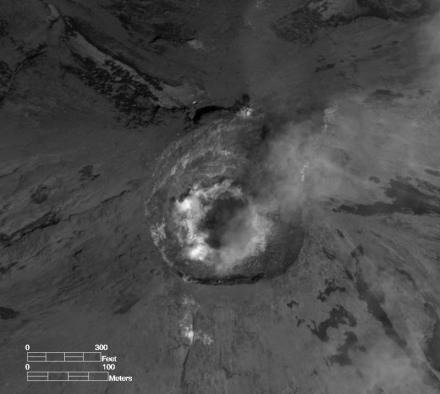
Cleveland Volcano experienced yet another explosion on Friday morning – its twentieth since Christmas.
Cleveland is one of the Aleutian Islands’ most active volcanoes. It’s been on watch for the better part of the past two years, and in June it blew ash 35,000 feet high.
Today’s explosion was small by comparison and didn’t produce a visible ash cloud, according to the Alaska Volcano Observatory. Since there isn’t any real-time monitoring equipment on Cleveland, the explosion was detected using infrasound and seismic equipment on nearby volcanoes.
A multi-million dollar grant is bringing broadband internet and videoconferencing equipment to public libraries across Alaska this year. Unalaska’s public library is using its new equipment to host workshops and reading sessions.
On an usually sunny afternoon in Unalaska, a handful of kids are clustered around a television screen in the conference room at the public library. A woman introduces herself.
“Well, my name is Ann Dixon. And I’m a writer and librarian. And behind me are some of the books that I have written.”
Dixon is a popular Alaskan children’s author, best known for her book Blueberry Shoes. She lives in Homer, so visiting Unalaska for storytime would normally be out of the question, but with the help of the library’s new videoconferencing equipment, it wasn’t a problem.
“What do you think you need when you start writing a book?" Dixon asks. The kids reply in unison: "Paper!”
Video chat isn’t exactly new technology, but it does require fast internet. And fast internet is expensive in Unalaska. $66,000 a year, to be precise. Librarian Dan Masoni says paying for that out of the library’s budget would require cutting other services. That’s where the $8.2 million dollar Online with Libraries or OWL grant comes in.
“The grant will bring high-speed broadband access into every public library in Alaska, videoconferencing into every public library in Alaska," Masoni says.
He thinks access to broadband internet creates new possibilities for residents -- possibilities that would other be unavailable.
“We are the, underlined, exclamation point, internet source for most of this community.”
Last year the library counted 150,000 people through the door - and most of them were there to use the internet. Masoni is optimistic that the faster speeds will encourage innovation - like storytime - although he hopes that in the long run, children aren’t the only beneficiaries of the new technology. He thinks the video conferencing equipment could be used by businesses for job interviews and meetings or by the public for lectures and research.
It’s clear there are still a few kinks to work out though. Halfway through a story, Dixon's voice turns into a nails-on-the-chalkboard screech. The kids look to the adults to fix the problem and the adults look around for someone in charge. Eventually it resolves itself.
Technical difficulties aren’t the only problem. Money is also an issue. The OWL funding is scheduled to run out next fall - and it’s unclear what will happen to the broadband connection at that point. Masoni says the state is working on funding packages, but so far, there’s nothing concrete.
“If the funding isn’t available from the outside, we’re going to massage our budget to keep good connectivity going here.”
It would be hard to go back to the slower speeds, for everyone.
“The fast internet, it can really spoil you," Masoni says. "I go home and I have a private circuit I pay for and I sit there and when it takes three to four minutes for Google to paint versus here when I just click it on, it’s there. Unfortunately, where we live put us at the short end of the stick for transmission speeds and that’s sad. But it will get better.”
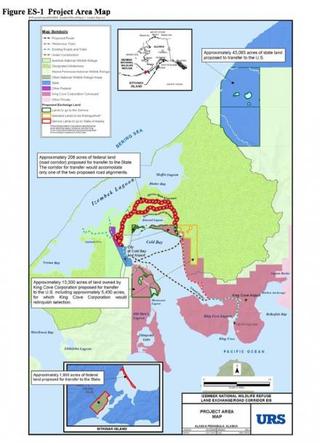
For years, King Cove residents have clashed with environmental activists over their plan to build a road through the Izembek National Wildlife Refuge. Locals say it could save lives by making medevacs easier, but activists argue that it would ruin ecosystems.
The U.S. Fish and Wildlife Service knew it would get plenty of responses from both sides when it asked for public comment on the road this summer. But they may have gotten a little more than they bargained for.
Even though it may look like one, The World is emphatically not a cruise ship.
“They call it a residence at sea,” says crew member Michael Moore. “Yeah. That’s the lingo.”
Moore is what’s called an expedition member, a person who comes aboard and helps facilitate some of the The World’s more extreme excursions. He and the rest of the gang aboard The World were in Unalaska for two days for a quick stop.