City council has a packed agenda for this evening’s meeting.
It will open with public hearing of an ordinance that ensures city employees don’t take pay cuts with promotions. Then council will move into work session.
First up will be some major budget housekeeping. A proposed ordinance moves $4.5 million dollars from the general fund to specific projects – the landfill waste storage tank and the Summer Bay road realignment – and accepts a $716,800 grant from the Environmental Protection Agency for the new water treatment plant. The ordinance covers several smaller allocations and adjustments as well.
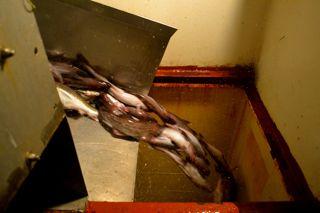
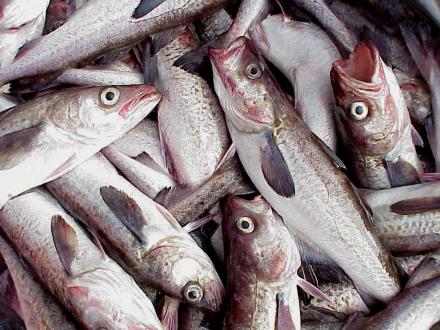
After salmon, pollock is Alaska’s most profitable fishery. It’s certainly the state’s most productive one, with fishermen harvesting a couple billion pounds of the fish annually. But recently, the stock has seen some ups and downs. After a couple of years of record low harvest limits, fishery managers raised this year’s cap by half. That didn’t go over well with some fishermen, who argued that the quota should be brought down once again at the North Pacific Fishery Management Council meeting in Anchorage.
After plenty of back and forth between regulators, industry representatives, biologists, and fishermen, the North Pacific Fishery Management Council has capped the amount of pollock that fisherman can catch in the Bering Sea next year at 1.2 million metric tons.
That’s a slight decline from this year’s quota. But for some members of the council, that number wasn’t low enough. Four of the eleven voting council members took the position that the total allowable catch should be set at 1.08 million metric tons, a 14 percent drop from 2011. Council member Ed Dersham said that the concern that some fishermen had expressed over the stock and their descriptions of slow fishing despite increased effort had persuaded him to favor a lower quota.
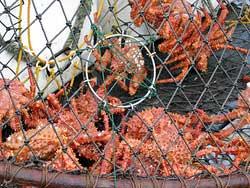
It was an efficient season for the six boats that fished Eastern Aleutian golden king crab this year.
The boats caught all 3.15 million pounds of quota before Thanksgiving.
According to the Alaska Department of Fish and Game’s preliminary figures, they owe their speedy season to a higher-than-average catch rate. Fishermen pulled up an average of 35 legal crab per pot. That’s almost 25 percent above the average since rationalization and a new record for the fishery.
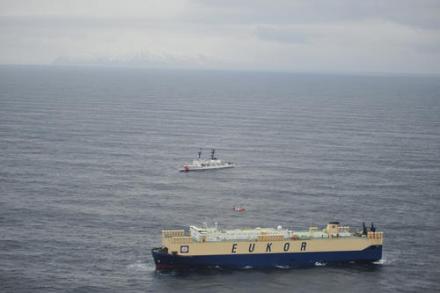
Technicians have temporarily repaired the rudder of the 656-foot cargo vessel Morning Cedar.
The vessel was en route from Vancouver, Canada to Japan with a load of packaged timber when a hydraulic leak left it without steering. It's been adrift in the western Bering Sea, north of Adak, since December 5.
Both the crew and the Coast Guard tried to fix the rudder without success. The Morning Cedar’s parent company, Eukor Car Carrier, contracted specialists from Norway and Washington to fly out and attempt repairs.
A stone that was used as a garden ornament for the last fifty years may turn out to be one of the most important archaeological finds in Aleutian history, offering new insights into Unangan culture.
The stone is two and half feet wide by three feet tall and weighs more than 250 pounds. Lifting it requires a forklift.
But the elaborate etchings that cover one entire side are delicate. Centuries, if not millennia, of erosion have smoothed any sharp edges, leaving a maze of ridges and valleys.
Last week the State Department of Labor released a report detailing trends in Alaska’s residential construction. Building has fallen off statewide in recent years and housing prices have flat-lined. But in Unalaska, the numbers don’t show dramatic changes.
Home construction in the rest of the state tapered off around 2006 and tanked in 2009, following the national housing market meltdown. The sample size for Unalaska isn’t huge, but it doesn’t show much of a response to those trends. Three new houses went up in 2006, two in 2009 and five in 2010.
At first light this morning, the F/V Cynosure pulled into its new home. The 58-foot longliner was the first boat to occupy a slip at the new Carl E. Moses small boat harbor.