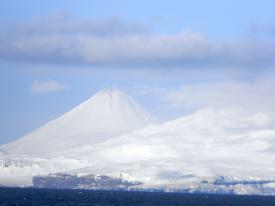
Two small explosions shook Cleveland Volcano on Friday. Scientists at the Alaska Volcano Observatory say the explosions didn’t produce detectable ash clouds. They’re just the latest in a series of low-level eruptions at the volcano.
There’s no real-time monitoring network on Cleveland, but scientists have been able to detect the eruptions using a network of distant air pressure gauges and seismic stations. Satellite images show slightly elevated surface temperatures in Cleveland’s crater, but the Observatory says there’s no sign of a new lava dome. The most recent dome was destroyed in an explosion two weeks ago.
A member of city council put in his resignation on Friday, citing a housing shortage as a primary factor.
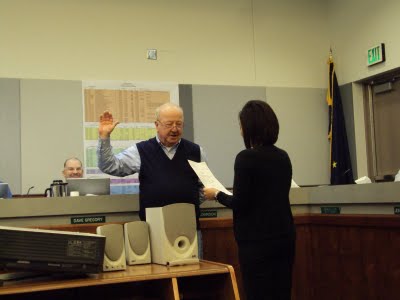
Councilor Dick Peck has accepted an interim management position with an electric company in Red Lodge, Montana. Though he will start his work with Beartooth Electric Cooperative this Monday, he will hold his council seat through the end of April.
Peck has been involved with city management and governance since he moved to Unalaska in 2004 to serve as the public utilities director. In 2006, he left that position and then ran for council. When reached on Friday afternoon, Peck spoke positively of his experience on city council. He said that he enjoyed being part of the team that built the new power plant and Carl E. Moses Small Boat Harbor, and that he’s proud of advocating for lower property taxes and the ban on smoking in restaurants and bars.
Jeff Williams / Alaska Maritime National Wildlife Refuge
On August 7, 2008, Kasatochi Volcano blew up. The explosion was large, unanticipated and completely devastating to life on the tiny Aleutian island. Prior to the eruption, Kasatochi was a thriving nesting site for hundreds of thousands of seabirds, but the eruption buried the island and the nests in dozens of feet of volcanic ash, completely destroying the local ecosystem.
Now, four years later, the island is experiencing a rebirth of sorts, with plants, insects and maybe even some birds beginning to resume residence.
The Arctic is changing rapidly. Not too long ago, scientists were saying it would take until the end of the century before the pole was ice-free in summertime. Now, some experts say that will probably happen in just a few decades.The rapid disappearance of the Arctic sea ice has profound consequences for Alaska and the rest of the far north, especially when it comes to development.
This summer is already set to be the busiest in Alaskan Arctic history, with Shell Oil expected to drill in the Beaufort and Chukchi Seas and increased shipping traffic transiting the Northern Sea Route. Is Alaska ready for development in the Arctic? What kind of policies do we have in place to ensure the people of the state benefit?
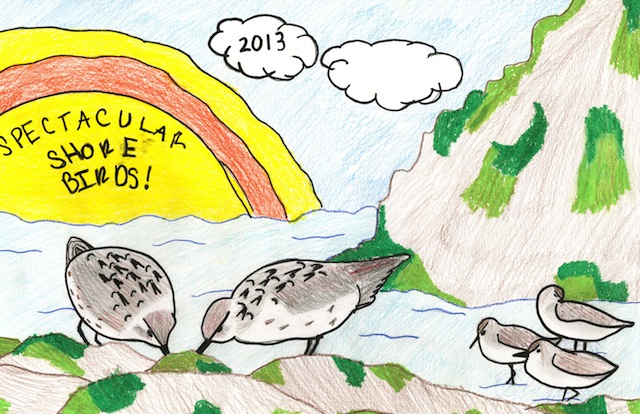
The Alaska Migratory Bird Calendar hangs in homes and offices across the state, showcasing avian-inspired student artwork. In 2013, three drawings produced by young Unalaskans will be featured in the calendar.
The Alaska Maritime Refuge released their regional contest results this month, and Mia McWilliams, Kiara Villamor, and Natalie Brown were among the 12 winners in the arts category.
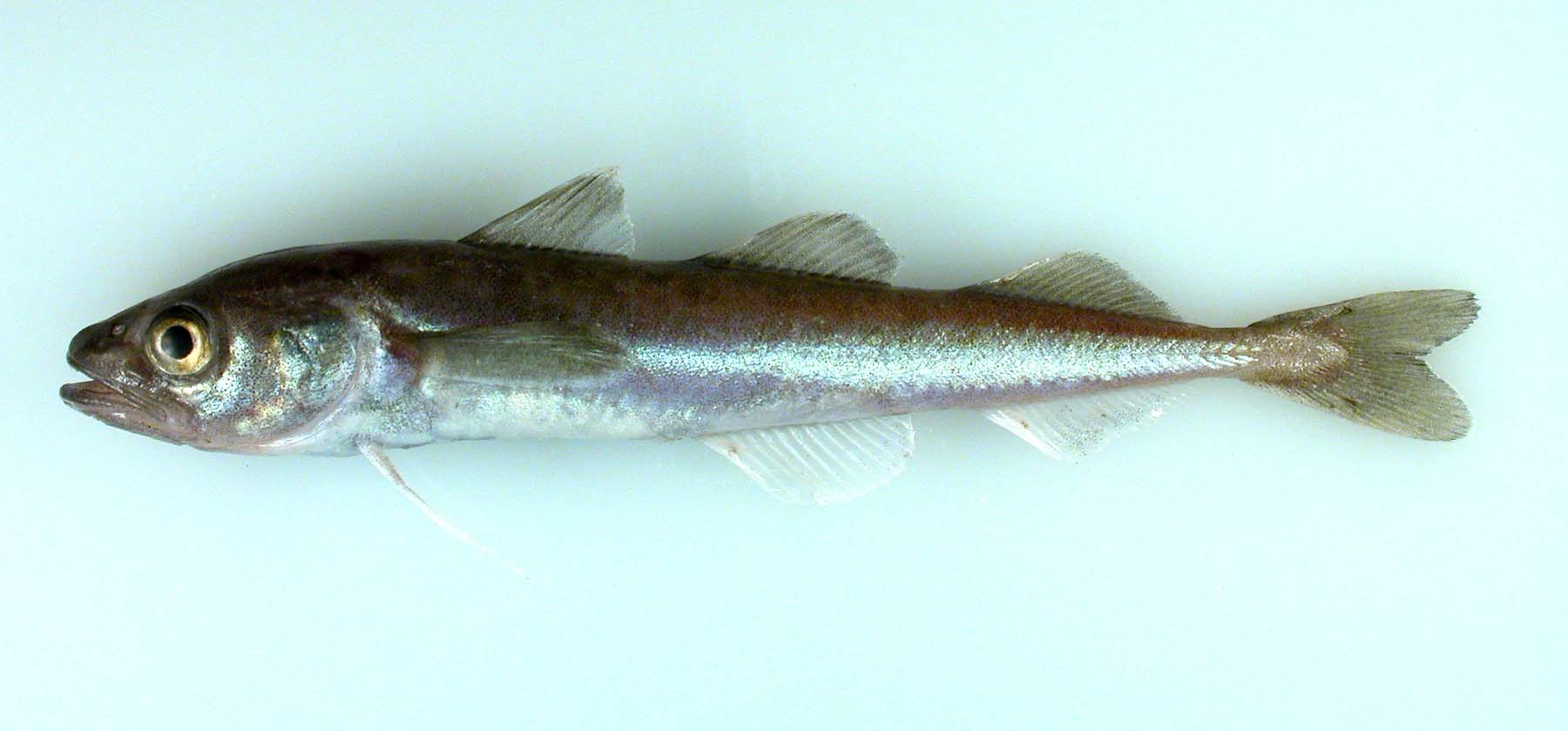
If breeding fish sounds tricky – it is. That’s why when the Vancouver Aquarium announced last week that biologists had successfully bred Arctic cod in captivity, it was hailed as a scientific breakthrough.
Arctic cod are one of the few fish in the world that thrives in temperatures below zero degrees Celsius, which makes them one of the most abundant fish in the far north. Aquarium senior scientist Tak Oyama says that makes Arctic cod a critical link in the polar ecosystem.
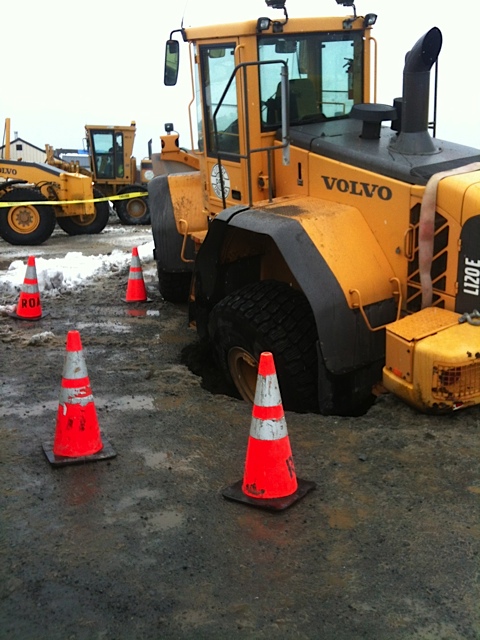
As winter comes to a close, drivers in Unalaska have been struggling to avoid potholes. Now, in a slightly ironic twist, a city loader got stuck in the largest pothole of all on Wednesday while doing road maintenance.
A Department of Public Works employee was removing snow from the Unalaska City School parking lot around noon when the dirt beneath the loader caved in, leaving its tire stuck in a hole approximately five feet deep and four feet long. When the dirt collapsed, it revealed a man-made structure covered in broken pieces of rotten wood.
The capital budget is out of the State Senate, and funding for Unalaska’s major projects hasn’t been slashed.
The Senate bill includes $4.1 million for the construction of a new wastewater treatment plant, a top priority for the city. Gov. Sean Parnell had only recommended $3.1 million for that project this year. The plant is expected to cost $16 million, and the city already received $4 million from the state for it last year.
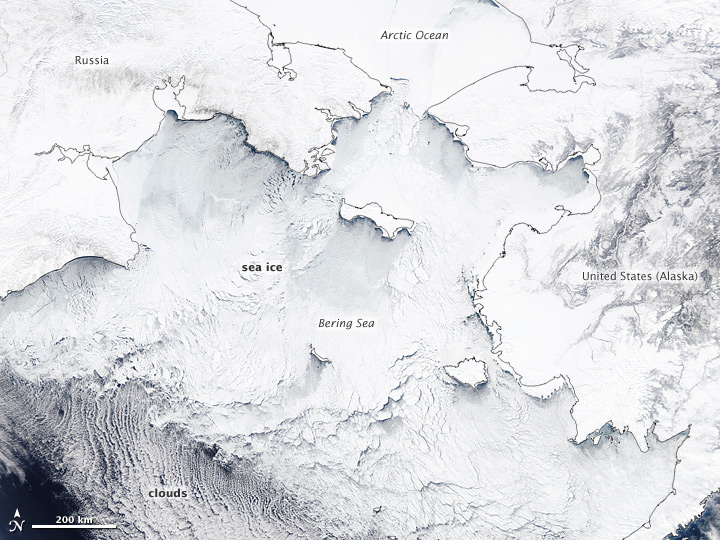
MODIS Image of Bering Sea Ice Cover on March 18, 2012 / NASA
The Arctic has crossed the threshold from winter into spring. Scientists at the National Snow and Ice Data Center announced last week that Arctic sea ice reached its maximum extent on March 18 and is slowly beginning its summer retreat.
Despite a chilly winter in some part of the Arctic, the overall ice cover was the ninth lowest since the satellite record began in 1979. That’s still a sizeable quantity of ice – 5.9 million square miles, or roughly the size of the United States and Canada combined – but about 200,000 square miles less than the 30-year average.